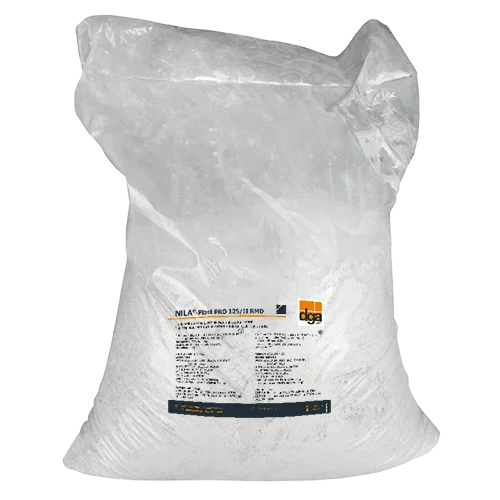

NILA®-Plast PRO 125/II RMD
Layable, structured hot plastic compound for type II markings, traffic class P7

Want to order or have questions?
Get in touch – we'll help you choose the right products, advise on usage and prepare a quote.
Description
We designed NILA®- Plast PRO 125 / II RMD specially for the creation of base line markings with regular agglomerates. This reflective marking material is suitable for creating markings on all types of asphalt road surfaces, such as roads, motorways and airports. Its composition guarantees improved night visibility. NILA®- Plast PRO 125 / II RMD is applied to surfaces at temperatures of between 190 and 220 degrees Celsius in a thickness of 1.9 mm and to regular agglomerates applied on top using a self-propelled laying machine with special markers. To produce the type II marking, the required structure is created using a special marker in a single work step.
Technical standards: DIN EN 1436, EN 13197
Advantages
- layable hot plastic compound for type II markings
- base line with regular agglomerates
- improved night visibility in wet weather conditions
- premium marking material with stone dust, sand and glass beads
- high softening point and resistance to deformation, low abrasion
- good grip with excellent adhesion and easy to use
Available packaging
Downloads
Technical info
Application instructions
Application
Material consumption
Storage
Shelf life of block material is unlimited. Shelf life of powder material is one year.
Technical data
| Base | Hydrocarbon resin, quartz sand, extender |
| Solvent | Solvent-free |
| Colour | White |
| Necessary working operations | basic-line in one application with regular agglomerate onlaid and drop-on |
| Specific gravity | approx. 2.03 g/cm³ |
| Softening point Wilhelmi | approx. 104 °C |
| Nüssel deformation | approx. 1.0 |
| Skid resistance | ≥ 45 SRT-units |
| Wear resistance (BASt, 4M roll-overs) | ≥ 90% (class P7, EN 13197) |
Want to order or have questions?
Get in touch – we'll help you choose the right products, advise on usage and prepare a quote.